
How to Help a Sweaty Kid Sleep Better in Singapore's Heat
The Quick Answer
Room temperature between 20-22°C is the target, but air circulation matters more than the number on the thermostat. Pair that with a bedtime routine that cools your child down (bath, loose clothing), moisture-wicking bedding that works with humidity rather than against it, and age-appropriate layers. Fabric choice is one piece of the puzzle—not the whole answer.
Why Singapore Heat Wakes Kids Up
Your child is lying there, sheets stuck to their legs, hair damp at the back of their neck, unable to fall asleep even though they're exhausted. It's not just discomfort—it's physiology.
Kids' bodies regulate temperature differently than adults. They lose heat more efficiently through their skin, but that also means they're more sensitive when the environment stays hot and humid. In Singapore, where temperatures sit between 25-32°C year-round and humidity never drops below 65%, your child's body gets conflicting signals: it wants to cool down to sleep, but the air isn't cooperating.
Add overnight sweating (which is normal) to fabric that doesn't wick moisture away, and you get a miserable, restless sleeper. That's not a character flaw. That's physics.
Room Setup: Temperature and Airflow
Most parenting advice assumes temperate climates. Singapore requires a different approach.
The AC target: 20-22°C for sleeping is the sweet spot, but this isn't universal. Some kids sleep well at 23-24°C, especially if airflow is good. Watch your child over a few nights—are they sweating, or are they comfortable? Adjust by 1°C at a time rather than guessing.
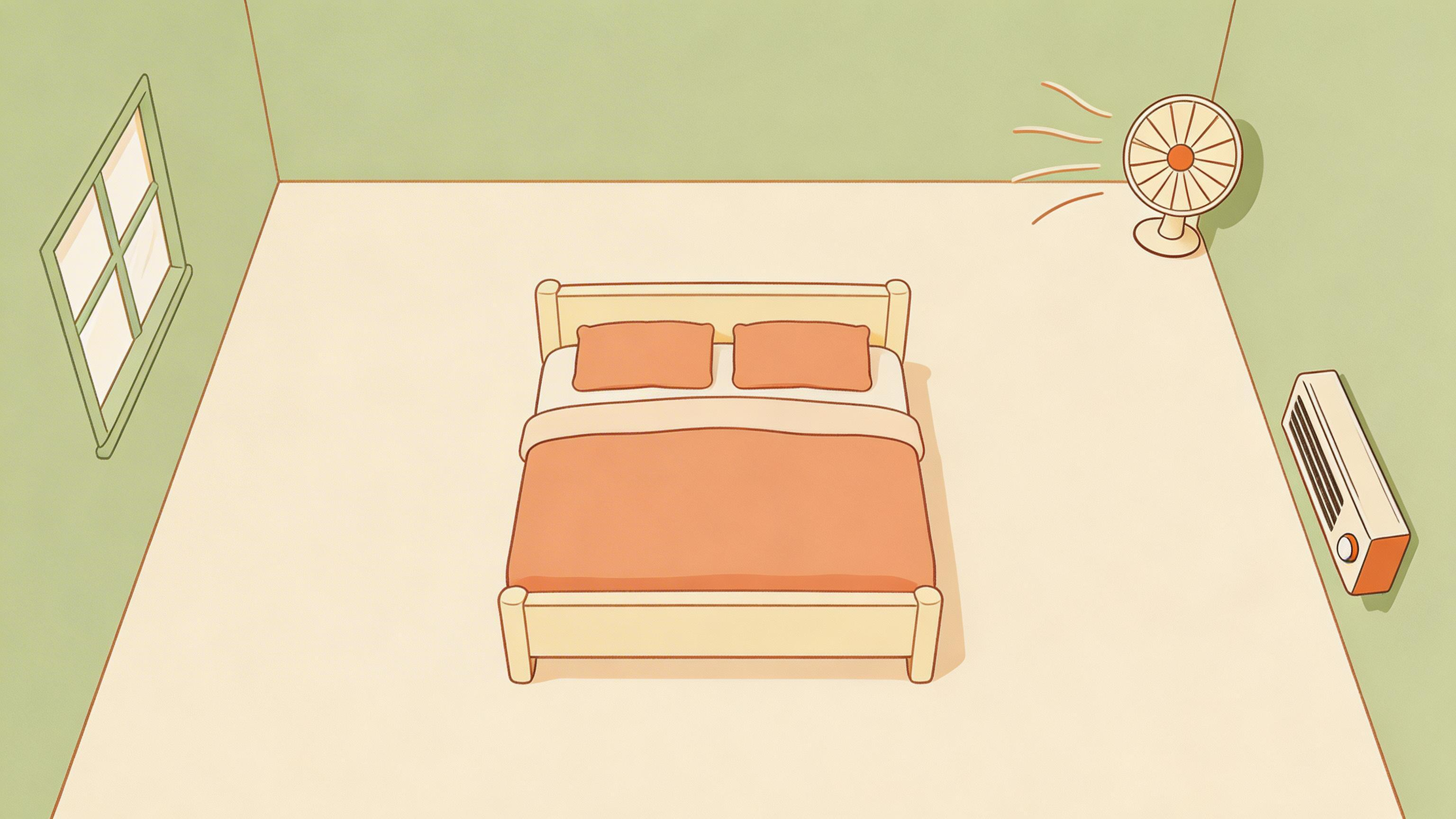
Air circulation is underrated. A room at 22°C with stagnant air feels worse than 23°C with a fan moving air across the bed. Position your ceiling fan or portable fan so it circulates air across your child's sleep space without blowing directly on them. This keeps moisture from pooling around the body.
Humidity matters too. If your AC is running properly, it should be dehumidifying naturally—but in a bedroom where the AC only runs part-time, humidity creeps back up. A basic humidity meter (under $20) tells you if you're sitting above 60%, which is when most kids start to sweat heavily at night. If you are, the AC needs to run longer or the room needs better ventilation.
Mattress choice affects heat retention. Foam mattresses trap heat; spring or open-weave mattresses breathe better. If your child sleeps on a foam mattress, add airflow underneath (a slatted base rather than a solid platform) so heat doesn't get trapped.
The Bedtime Routine That Actually Cools Them Down
Room temperature is only half the battle. Your child's core body temperature needs to drop before sleep, and Singapore's heat works against that.
A lukewarm bath (not cold—that shocks the system) about 30 minutes before bed helps. The warm water dilates blood vessels and lets the body release heat more easily. Follow it with light, breathable clothing—cotton pyjamas in sizes that actually fit, not oversized hand-me-downs. Tight clothing traps heat; loose clothing lets air flow around the skin.
Skip the heavy blankets and thick quilts entirely. In Singapore, a single lightweight cotton or bamboo sheet is usually enough. Some nights, even that is too much. That's fine. Your child can sleep under a sheet when it's cooler and without one on humid nights.
Avoid caffeinated drinks (which is usually just Milo or Ribena, but worth saying) in the afternoon. Caffeine interferes with the natural temperature-drop that triggers sleep.
Fabric: What "Breathable" Actually Means
This is where fabric choice enters the picture—not as the whole solution, but as a meaningful piece.
Breathability means the fabric allows moisture to wick away from the skin quickly and lets air move through the weave. In humidity, this matters because sweat won't evaporate from the skin surface the way it does in dry climates. The fabric has to actively pull moisture away.
Cotton breathes well and moisture-wicks reasonably fast, but it absorbs sweat and holds onto it. Your child feels wet. After several hours, the sheet becomes damp and clammy.
Bamboo viscose absorbs 40% more moisture than cotton but releases it faster. It also has natural temperature-regulating properties—bamboo fabric actually helps skin feel cooler. For a sweaty sleeper in Singapore, bamboo is noticeably better than standard cotton, and you'll see the difference in wake-ups.
TENCEL Modal is the premium option. It wicks moisture faster than both bamboo and cotton, making it ideal for the heaviest sweaters or for children with sensitive skin that reacts to dampness. The tradeoff is cost.
Synthetics (polyester blends, microfiber) don't wick at all. Avoid them for a hot sleeper. They trap sweat against the skin.
For Singapore specifically: buy two sets of sheets in a moisture-wicking fabric so you can rotate them. On humid nights, you might swap a damp sheet in the middle of the night. Having a backup ready saves you from waking a sleeping child.
Construction Details That Actually Matter
Beyond the fibre itself, how the fabric is constructed affects performance:
Thread count is less important than you think. A 400-thread-count bamboo sheet outperforms a 600-thread-count cotton sheet in humidity. Higher thread counts usually mean tighter weaves, which trap moisture. You want a looser weave that lets air flow through.
Weight matters in Singapore. Look for lightweight or medium-weight sheets, never heavy. A 100-150 GSM (grams per square meter) bamboo sheet is better than a 200+ GSM cotton sheet for hot sleepers.
Seams and edges should be flat-stitched or french-seamed so they don't irritate skin that's already sensitive from sweat and humidity. Rough stitching + humidity = irritation.
Care Tips for Tropical Climates
Washing affects how well moisture-wicking fabrics work:
- Wash in cool water to preserve the fibres (bamboo especially degrades in hot water)
- Skip the fabric softener, which coats the fabric and reduces breathability
- Air-dry when possible rather than tumble-drying, especially for bamboo
- Wash every 2-3 days during hot months if your child sweats heavily. Damp sheets breed bacteria fast in humidity
A worn-out or degraded sheet won't wick as well as a new one, so replace them annually if your child sweeps heavily.
FAQ: Your Actual Questions
What AC temperature is safe for kids? 20-22°C is standard. Going below 20°C risks the child catching a chill. Going above 24°C, most kids start sweating at night. Adjust by 1°C and observe.
How many sheet sets should we own? For a heavy sweater in Singapore, at least two. Three is better so you're never washing sheets while the child is sleeping on a damp one.
Is one pyjama set enough? No. Buy lightweight, breathable pyjamas in at least two sets so one can be washed while the other is in rotation.
Can I use a fan instead of AC? Fans help with air circulation and can make a room feel 2-3°C cooler, but they don't actually lower the temperature or dehumidify. In peak Singapore heat (30°C+), a fan alone won't solve sweaty sleep. AC does both.
When do kids stop sweating so much at night? Most children's night sweating reduces significantly after age 5-6, and stabilises by age 8-10. Until then, it's normal physiology, not a sign of illness.
What if my child hates being cold? Some kids have a naturally higher temperature set point. If your child won't settle below 23-24°C, add airflow instead of dropping the temperature further. A fan + good airflow might solve the problem without the cold resistance.
Related reading
- best fabrics for kids pyjamas (cross-pillar)
- why my toddler sleeps better in bamboo (cross-pillar)
- AI bedroom design on a budget (cross-pillar)