
How to Build a School Week Morning Routine That Actually Works
The answer upfront
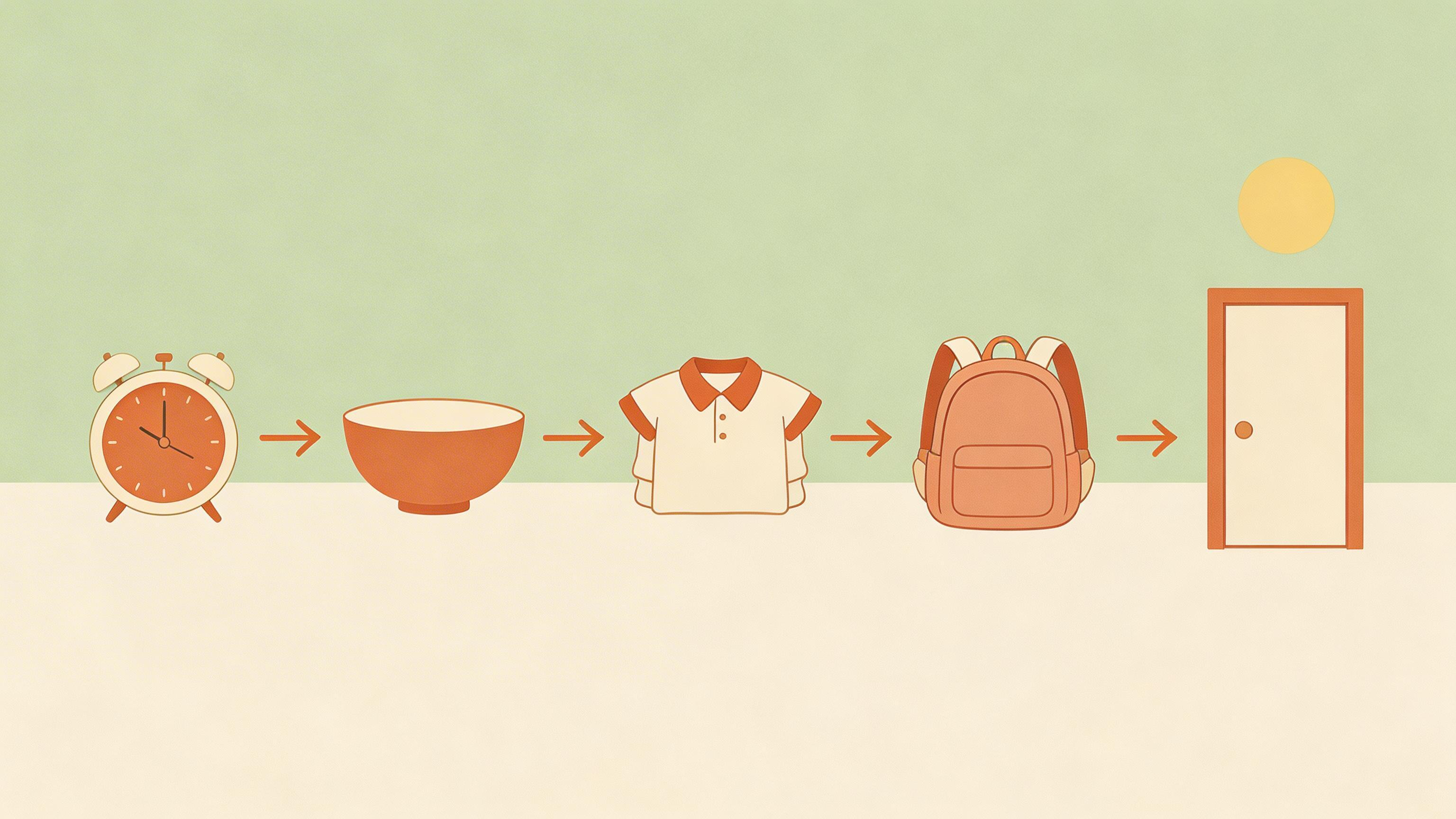
A working morning routine isn't about perfection. It's about knowing the minimum — what absolutely has to happen before school — and building just enough structure around it that you're not negotiating everything. For most families, that's: breakfast, getting dressed, teeth, shoes, leave. The magic isn't in the routine itself. It's in removing decision points.
Why most routine advice fails
You've probably read about the ideal morning: kids wake up cheerfully, shower without complaint, eat a full breakfast, pack their own bags, arrive early.
That's not a routine for a Tuesday. That's a screenshot.
Most routine guides assume either that your kids have no resistance or that you have unlimited time to train habits perfectly. Singapore mornings aren't like that. You've got 45 minutes before the school gate closes. Someone's still looking for their tie. Someone else woke up grumpy. You haven't had coffee.
The advice that doesn't work: "wake them earlier" (they'll just be grumpy earlier), "make a chart" (charts stop working around month two), "give them ownership" (ownership is great on Saturdays, not school days), "use positive reinforcement" (rewards stop being reinforcing when the routine becomes automatic).
What does work: removing friction. Making the path to "left on time, kid fed, uniform on" the easiest path in the house.
The minimum viable morning
Before you design anything, know what actually has to happen:
- Your child has eaten something (breakfast, not just juice).
- They're wearing their uniform and shoes.
- They've brushed their teeth.
- You've left the house on time.
Everything else is a nice-to-have. Their hair doesn't have to be perfectly combed. Their water bottle doesn't have to be packed (the school has water). Their bag doesn't have to be checked (they'll figure out what they need, or the school will call you).
The routine that works:
- Wake-up (15 mins before everything else): One alarm, no snoozing. If your child won't get up, that's a sleep issue, not a routine issue — fix the bedtime first.
- Breakfast (10 mins): Not a banquet. Toast, cereal, a boiled egg, fruit. Something warm if it's cold outside, something light if they're grumpy. Have it on the table before they arrive downstairs.
- Get dressed (8 mins): Uniform laid out the night before. Shoes by the door. No choosing.
- Teeth (3 mins): While you're doing something else. Teeth, sunscreen (if it's a long day), done.
- Leave (2 mins): Bag by the door, keys in hand, out.
Total: 38 minutes. Adjust for your house.
The secret to this working: everything is prepped the night before. Uniform ironed and laid out. Breakfast stuff accessible. Bag at the door. You're not making decisions in the morning; you're just executing a path.
Age adjustments
Ages 5–7: They need more reminders and more help. Lay out clothes. Prepare breakfast. Use a picture chart if it helps you stay on track, not them. Don't expect them to remember steps independently.
Ages 8–10: They can do most of it if the path is clear. Uniform out, breakfast ready, they can brush their teeth without asking twice. Still need a 5-minute warning before "time to go."
Ages 11–14: They forget on purpose half the time (it's normal). Uniform still laid out if you want mornings to not be a fight. Let them make their own breakfast if that's faster. But the pattern should be: they know the timeline, you enforce the timeline, and there's no negotiating when to leave.
Ages 15+: They can mostly handle it. If mornings are still chaotic at this age, the problem is usually that they didn't sleep or they're actively avoiding school for a reason (not a routine reason).
The single change that makes the biggest difference
Stop asking your child to decide things in the morning.
No "what do you want for breakfast?" — it's this or that. No "have you chosen your clothes?" — clothes are chosen. No "shall we leave now?" — you're leaving in three minutes.
Decisions before 8 AM should be near-zero. Decisions fatigue is real. Your child has used up their decision budget by the time they sit down for first period. Use your authority to remove choices, not to force compliance.
What to do when it breaks down
Some mornings will still be chaos. A child is sick. Someone spilled juice on their uniform. The car won't start. That's not a routine failure; that's life.
For the chronic breakdowns — the kid who's always running 15 minutes behind, the mornings that always end in yelling — stop and ask: is this a routine problem or something else?
- Routine problem: They don't know what's expected. Fix it by removing decisions and prepping the night before.
- Sleep problem: They're tired because bedtime is too late or wake time is too early. Fix the sleep, not the routine.
- Anxiety problem: They're stalling because they're worried about school. The routine won't fix that. You need to address what they're worried about.
- Power struggle: They're resisting because the morning feels like constant reminders and nagging. Step back. Make the path easier, not the rules stricter.
If the same thing breaks down every week at the same point, that's information. The routine isn't broken; something else is. Fix the thing.
FAQ
Q: My child won't eat breakfast. A: Some kids genuinely aren't hungry in the morning. A drink and a piece of fruit is enough. If they're ravenous by 10 AM, pack a snack. Not worth a morning fight.
Q: Their school bag never has what they need. A: Not your job to fix from the morning routine. Let them own it. They'll figure it out or the teacher will email you. This will take two weeks and then they'll remember.
Q: The whole house is chaotic — I can't prep everything the night before. A: You don't have to do everything. Do the uniform and the breakfast. That's 70% of the friction. Start there.
Q: My child is anxious about school and mornings are when it shows. A: Morning routine won't fix this. The routine should stay calm and consistent, but the anxiety is separate. Talk to the school, talk to your child, consider whether there's something happening at school that needs attention.
Q: What if we're running late? A: You leave anyway. Lateness is its own problem. It's not the routine's job to magic up time you don't have. Wake earlier or leave earlier or accept you're going to be late and deal with the school policy. But don't blame the routine for the math not adding up.
The real goal
A working morning routine isn't about raising perfect kids or having a perfect morning. It's about getting from asleep to out-the-door with minimum friction and maximum dignity for everyone.
Some mornings will be rough. Some kids will still resist. That's normal. The routine is just the container that makes the normal mornings easier, so you have energy left over for the ones that aren't.
Related reading
- new school year checklist (same-pillar)
- organise the school year with AI (cross-pillar)
- why kids do not listen (same-pillar)