How to Use AI to Create a Family Recipe Book
My grandmother's laksa recipe was written on a piece of brown paper in her handwriting, held together with cellotape and a lot of hope. I had no idea if it was the only copy. I had no idea if my daughter would ever want to make it.
The day Grandma passed, I realised I'd never properly written it down.
Three years later, I found another copy in a box, and I decided: this year, we're making a family recipe book. Not a fancy cookbook. Just ours.
What this actually is
A family recipe book is not about becoming a chef or winning a food blog award. It's about:
- Capturing recipes before they disappear
- Involving your kids in the process (they learn while you digitise)
- Creating something printable and real — a book you can hold, gift, and pass down
- Preserving the stories and memories attached to each recipe
AI makes this faster and less painful than you'd think.
How to use AI to build it
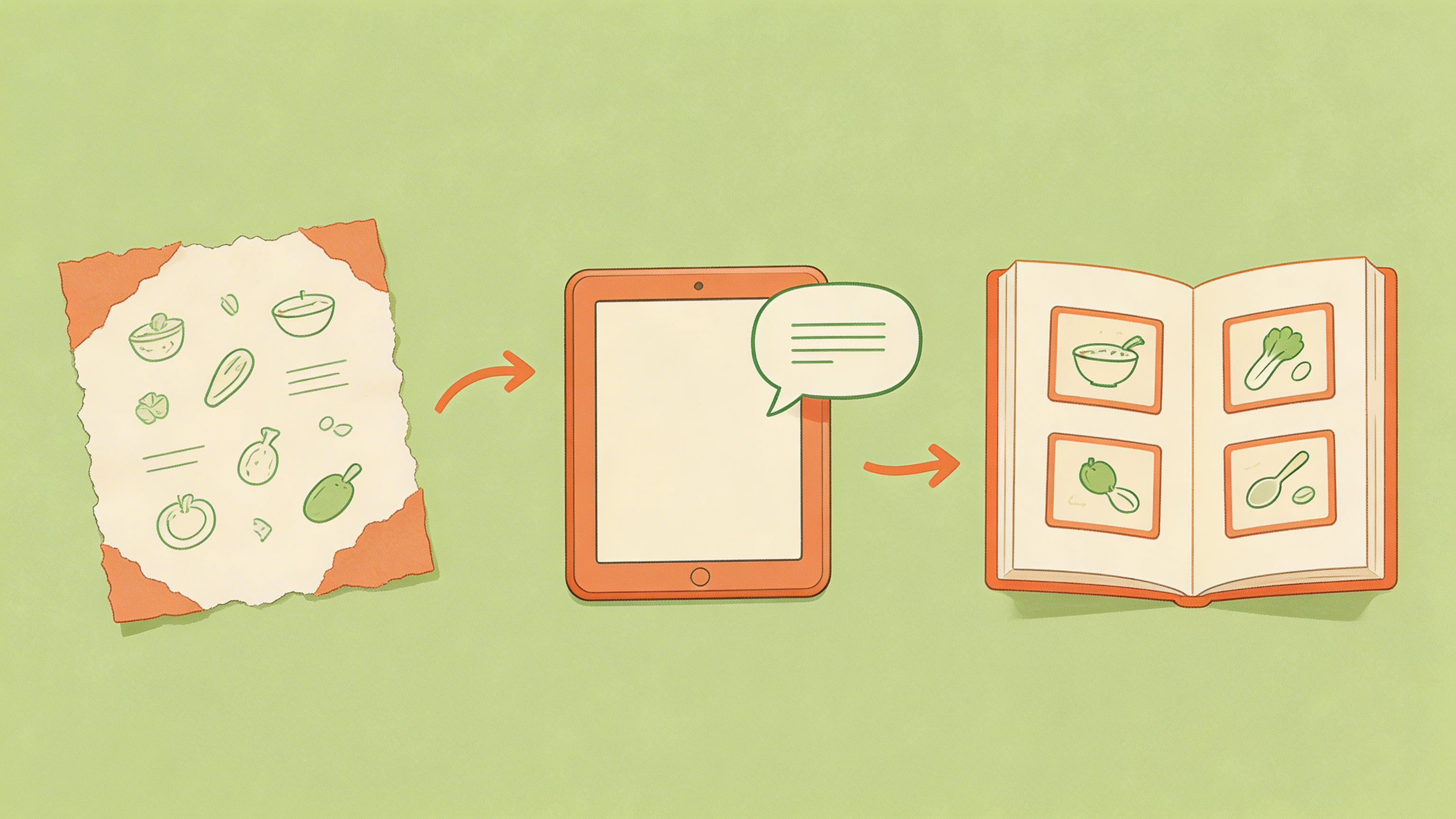
Start with what you have. Gather every recipe. The ones in your head, the ones your mum has, the handwritten notes, the printed ones stained with years of use. Photo them if they're written down. Just gather.
Feed them to AI. Open ChatGPT (or Claude — any AI chatbot works) and give it this prompt:
"I have [number] family recipes I want to compile into a cookbook. Here's the first one: [paste or type the recipe]. Please format this as: - Recipe name - Serves: [number] - Prep time: [time] - Cook time: [time] - Ingredients (clear list) - Method (numbered steps) - Chef's note (any tips or history)"
AI will clean it up, format it, make it readable. Do this for each recipe.
Ask AI to add headnotes. For each recipe, ask: "Write a 1-2 sentence headnote for [recipe name]. Include any family history or context if provided." This is where the book becomes yours rather than generic. "Grandma made this for Hari Raya" or "Dad's Sunday breakfast staple" matters.
Involve your kids. Ask them to test a recipe and write what they notice: "What did it taste like? Was it easy? Would you make it again?" Their writing goes into the book, word-for-word. This is the inheritance piece — their voice in the family story.
Create a table of contents and index. Ask AI to categorise the recipes (breakfast, sides, desserts, festive) and create a table of contents. Add an index by ingredient if you want it searchable.
Print and bind
Google Docs or Canva can take your formatted recipes and turn them into a PDF. Print double-sided, bind it with a spiral spine (any local printing shop can do this for $15-30), and you have a real book.
Or just keep it as a PDF for your family WhatsApp. Either way, it exists now.
Why this matters more than you think
Recipes carry memory. They carry culture. They carry the way your grandmother stood at the stove, the way your dad measured "a handful" of something, the way your child's nose scrunched the first time they tasted it.
When you digitise a recipe, you're not losing the human part. You're protecting it. You're making sure it survives the piece of brown paper, the cellotape, the box in the cupboard.
And when your child comes home from university with a partner and says, "I want to cook something from my family," they'll have this book. It won't be a vague memory of what it might have tasted like. It'll be exact. It'll be theirs.
That's the point.
Related reading
- AI meal planning for families (same-pillar)
- ripe mangoes at the market using AI (same-pillar)
- build a song with your child using AI (same-pillar)