
How I Solved the Rubik's Cube With AI (And Then Taught My Kid)
My brother solved a Rubik's cube in 4 seconds.
He's actually fast — competed at the World Championships. But even watching him solve it casually, it looks like pure magic. Hands moving. Cube spinning. Done.
I couldn't do it in 10 years if I tried.
Or so I thought.
Then I tried it with AI. And something shifted.
This is the story about how AI can actually teach you something real. Not just tell you information. But guide you through learning a physical skill, step by step, until you can do something you genuinely thought was impossible.
And what that taught me about teaching my own kid.
The setup: completely stuck
I'm not particularly mechanically minded. Spatial reasoning isn't my thing. When I looked at a Rubik's cube, I saw chaos.
But I was curious. Stubborn, too. "If everyone can learn this, why not me?"
I tried YouTube tutorials. Too fast, too many steps, too much jargon. I'd memorise step 1, forget step 1 by step 3. Frustrating.
Then I thought: what if I use AI as a personal tutor?
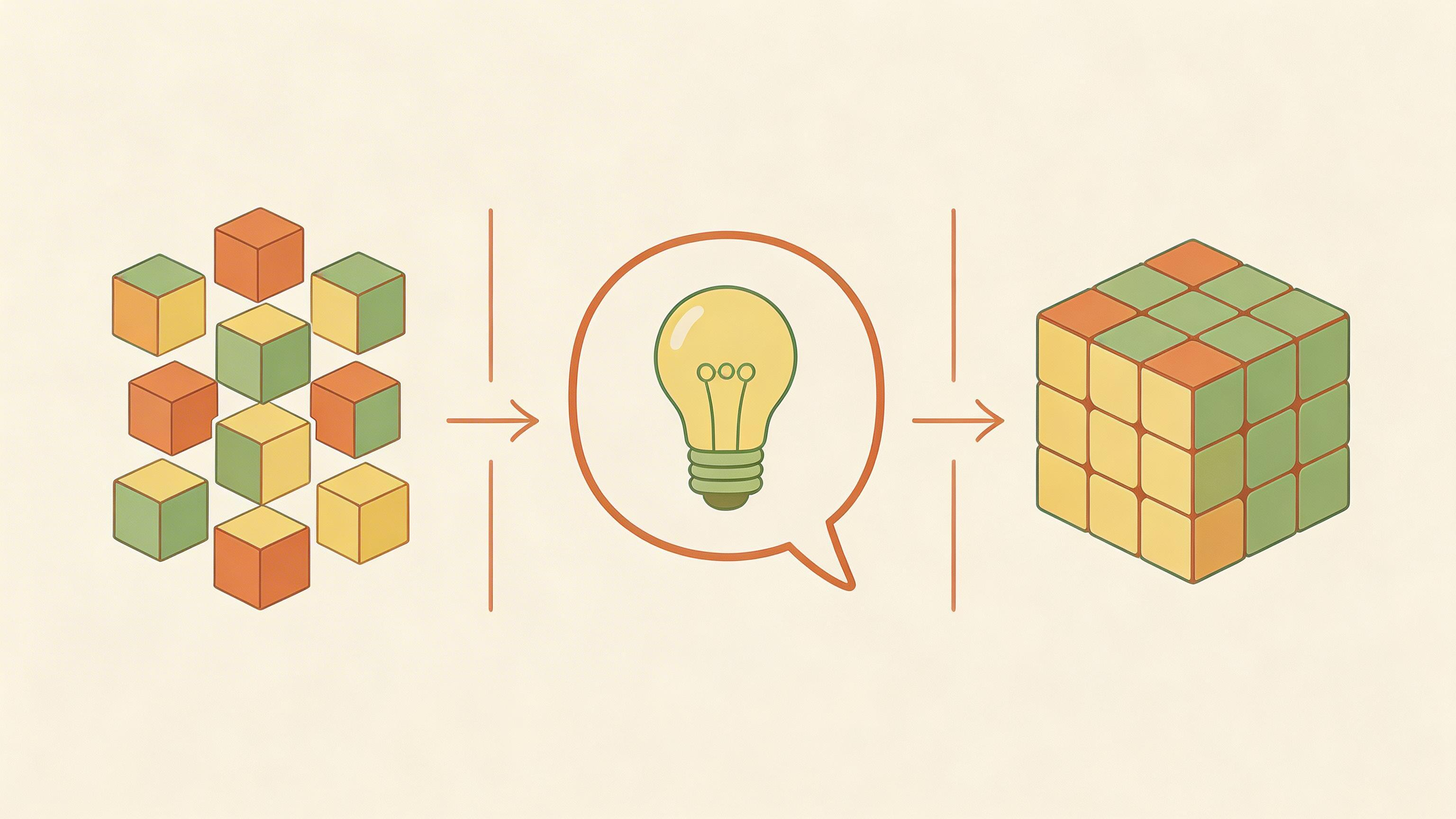
The process (this is the important part)
I opened Claude and gave it this prompt:
I want to learn to solve a Rubik's cube. I have zero experience.
I learn best by doing one small thing at a time and understanding *why* before moving forward.
Walk me through the first step only. Explain it clearly with reason. Then ask me to try and report back with what I see.
This was the key: I didn't ask for a complete guide. I asked for step-by-step dialogue.
AI explained the white cross — solving the first side's edges. It explained the reasoning: "The white side will be your foundation. You're teaching yourself which direction pieces move."
Then it said: "Now you try. Tell me what you did and what you see."
I attempted it. Messed up. Reported back. AI asked clarifying questions:
"When you rotate that face, what colours do you see on the adjacent sides?"
This is Socratic teaching. It was adjusting to what I didn't understand, not just lecturing.
We spent 15 minutes on the white cross. Just that. Then:
"Good! You've figured out the first layer."
Tiny win. But it felt real.
Next session, I kept the white cross and moved to the second layer. AI explained how pieces fit into the edges. It asked me to try, I reported back, it guided me through what went wrong.
Same pattern. One layer at a time.
After four sessions over two weeks, I had the fundamentals. I could solve about 80% of the cube. The last layer (the top) was still manual luck, but I understood the system.
By week three, I'd solved it. Completely. Legitimately.
It wasn't fast. Took me 3 minutes. But I solved it.
Why this worked
Three reasons:
I had a patient guide who never got annoyed. YouTube tutorials judge you (or feel like they do). Human tutors have limited patience. AI asks the same question five times without frustration.
I learned why before how. Most people teach Rubik's cubes as: memorise these rotations. Do these in this order. AI explained the underlying logic first. Once I understood why pieces move that way, the how made sense.
I solved it in small, verifiable steps. Not "learn to solve a Rubik's cube." Just "master the white cross." Then "add the middle layer." Then "solve the top." Each piece was a win, which kept me motivated.
Teaching my kid
Once I'd solved it, my child got curious. "You did it? Can you teach me?"
Here's what I did differently:
I didn't try to teach them the same way. I gave them an AI tutor.
I set up a prompt:
My 10-year-old is learning to solve a Rubik's cube for the first time.
They're visual, creative, and impatient with long explanations.
Walk them through the FIRST STEP only — solving the white cross.
Use simple language. Be encouraging. Then ask them to try and report back.
Then I sat with them while they used it.
Here's the magic part: they weren't learning from their parent (which can feel like pressure). They were learning from AI (which feels like a friendly guide).
And I could see them actually enjoying problem-solving instead of getting frustrated.
They got stuck. AI asked better questions than I would have. They figured it out. Tiny win. Big excitement.
It took them longer than me (they're 10, they have less patience for repetition). But they got it. And they felt proud.
What this taught me about learning
Using AI to learn something physical — something that requires doing, not just knowing — changed how I think about skill-building.
Breaking things into steps actually works. Not "learn to solve a Rubik's cube." Just "master the white cross." Once you do, the next step isn't as scary.
Understanding the system matters more than memorising steps. I see kids memorise cube algorithms without understanding why. They can do it, but they're fragile learners. Ask them to adapt? They're lost. When you understand the logic, you can adapt.
A guide who asks questions beats a guide who gives answers. The AI wasn't faster than a good YouTube tutorial. But it was way more educational because it made me think.
Patience compounds learning. AI never lost patience. I could ask the same thing three times and get a clearer answer. Real learning needs that.
Other skills you could do this with
Once you realise AI can guide you through learning to do something, the possibilities expand:
- Magic tricks. Learn the tricks. Understand the mechanics. Teach your kid how they work.
- Drawing. Step-by-step guidance on perspective, shading, anatomy. AI asks: "What do you see when you look at the shadow?" You think. You improve.
- Coding basics. Building a simple website or game. AI explains concepts, guides you through problems, celebrates wins.
- Chess. Move by move analysis. "What was your thinking there?" It makes you better.
- Music. Learning an instrument. Rhythm, finger placement, reading music. AI can guide through each piece.
- Cooking. Master one technique at a time. Emulsification. Caramelisation. Knife skills. AI explains the science.
The pattern is the same: one small skill, understanding first, guided practice, then celebration.
The real win
I could have watched my brother solve cubes and just... accepted that I couldn't do it.
Instead, I spent a few weeks learning with an AI guide. I solved a Rubik's cube. Then I taught my kid.
Now my kid is actively interested in spatial reasoning, puzzle-solving, and persistence.
The Rubik's cube itself? Not important.
The realisation that you can actually learn things if someone (or something) breaks them down patiently? That's huge. That transfers everywhere.
And it started because I was stubborn and an AI didn't mind me being slow.
For that, I'm genuinely grateful.
Related reading
- AI as a patient tutor (same-pillar)
- build a simple app with your child (same-pillar)
- what my kid taught me about learning (cross-pillar)